| Ardee's Main Screen |
|
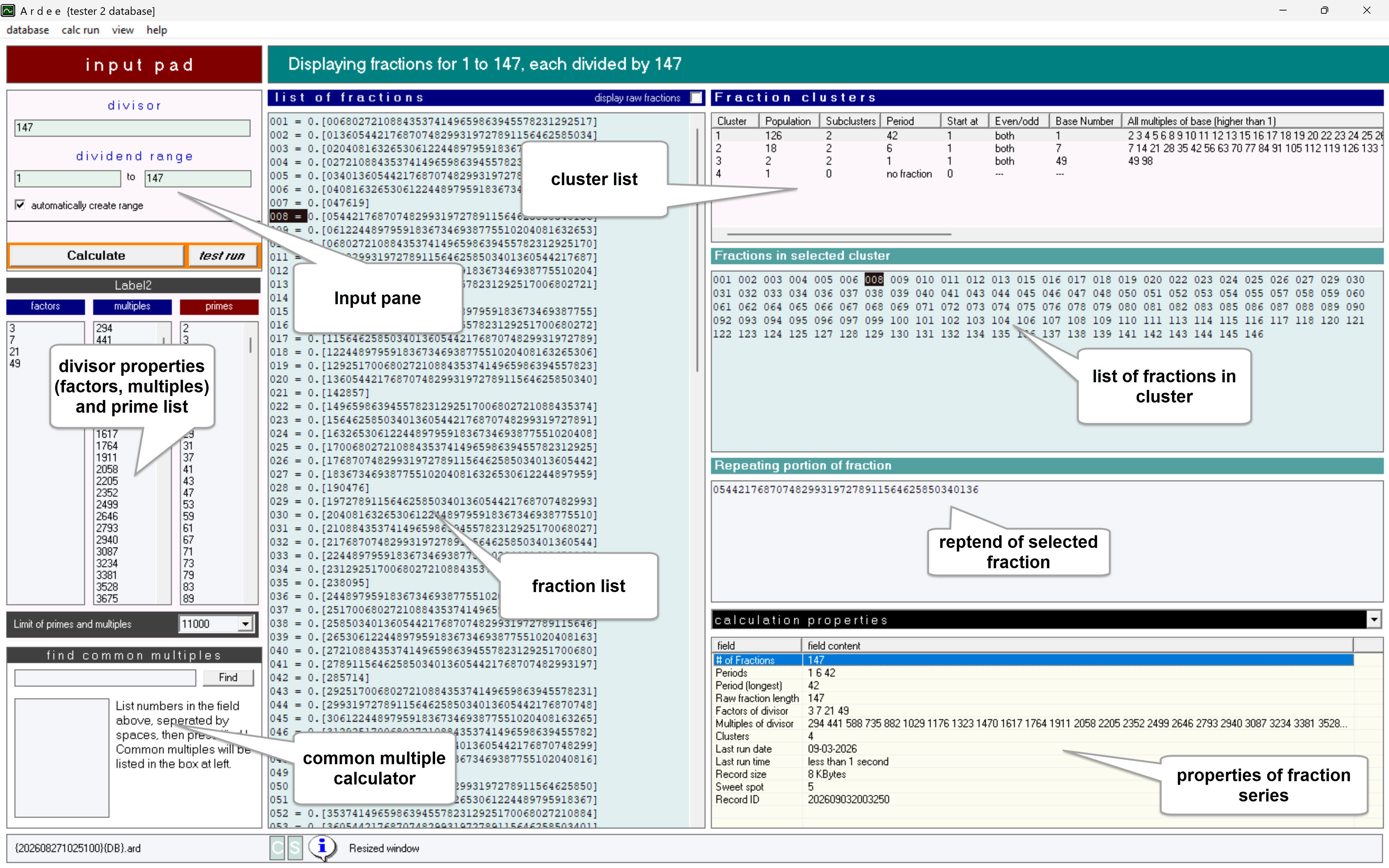
Ardee's main user interface is as shown above. It displays all the information obtained regarding the series of fractions defined in the green banner at the top of the pane. Here are the numbered elements:
1. Input pane
2. Fraction list This is a formatted list of all the fractions in the series, showing the repeating portion within brackets.
3, 4, and 5. Cluster list
6. General data about the displayed fraction series
7. A note field where you may put your own notes of comments on the fraction series.
|
| |
| Input Pad and Fraction List |
|
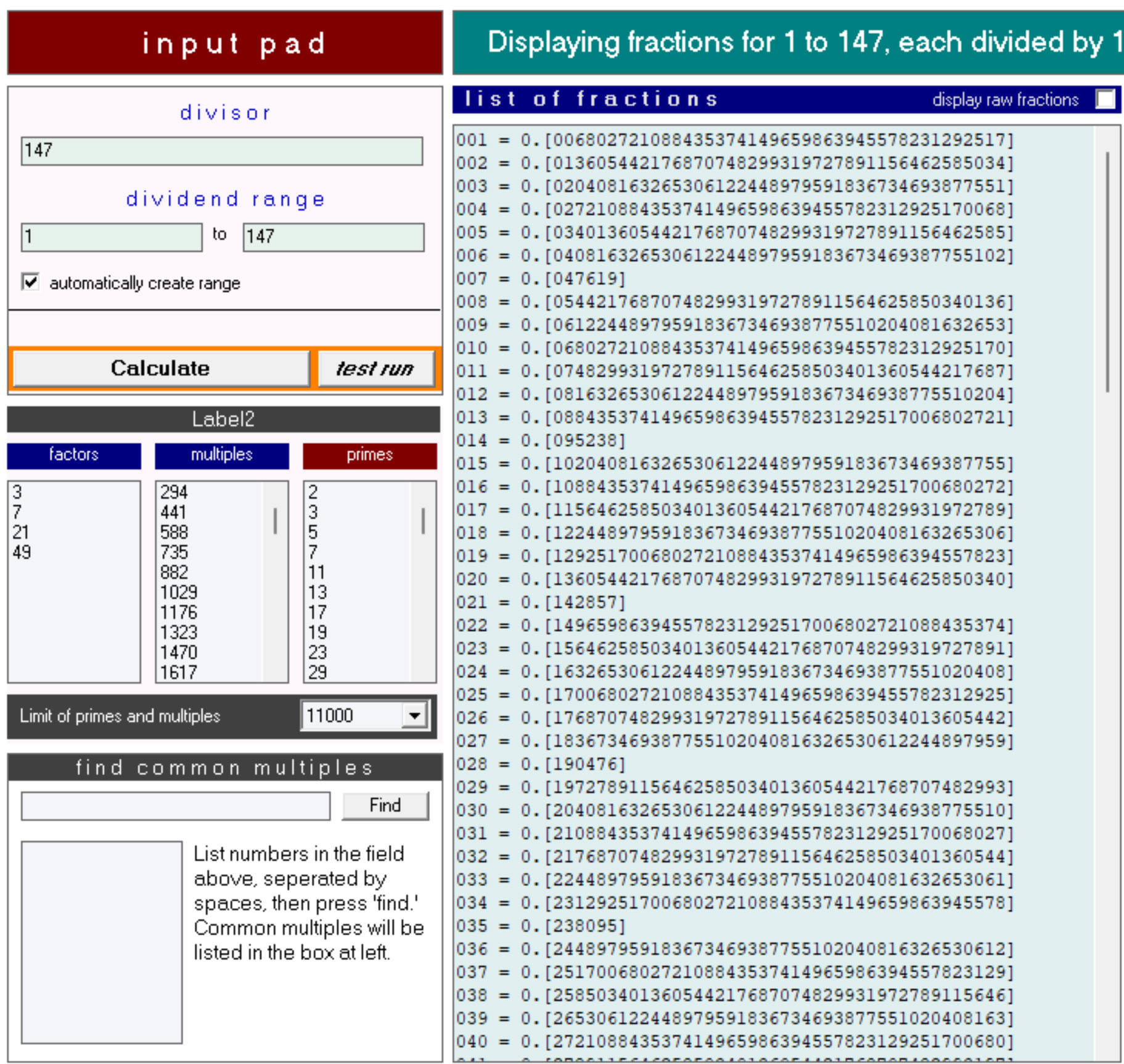
1. Input Pane The input pane has three sections:
Input pad is where the series of fractions to be calculated is defined. It consists of a divisor field and two fields defining the bottom and top of the range of dividends. There's an automatically create range checkbox; if checked it will create a range of one to the divisor. For example, for a divisor of 49 and a dividend range of 1 to 49, Ardee will divide each number in the range by 49 and display the repeating decimal portions of each fraction, if they are found. The calculate button will initialte the calculation; the test run button will run an abbreviated portion of the range in a "sandbox" and display detailed results of the resources required the calculate the whole series. This is a valuable option for very large numbers likely to result in fractions with very large repeating periods (the larger multiples of 7 for example).
Factors, multiples, and primes display These lists are linked to the divisor field; when you put a number in the divisor, these lists will display its factors and multiples; if it is a prime it will be highlighted in the prime list. If you double click on a number in any of these lists that number will be placed in the divisor field, and the contents of each list will change accordingly. Immediately beneath these lists is the "limit of primes and multiples" selection field; the number you select here will determine the limits of the respective lists.
Find common multiples If you want to know if a series of numbers have common multiples, put those numbers in the first field and press the find button. The common multiples will be displayed in the list box. Double clicking on a number in the list box will place it in the divisor field.
|
| |
| Cluster List and Display |
|
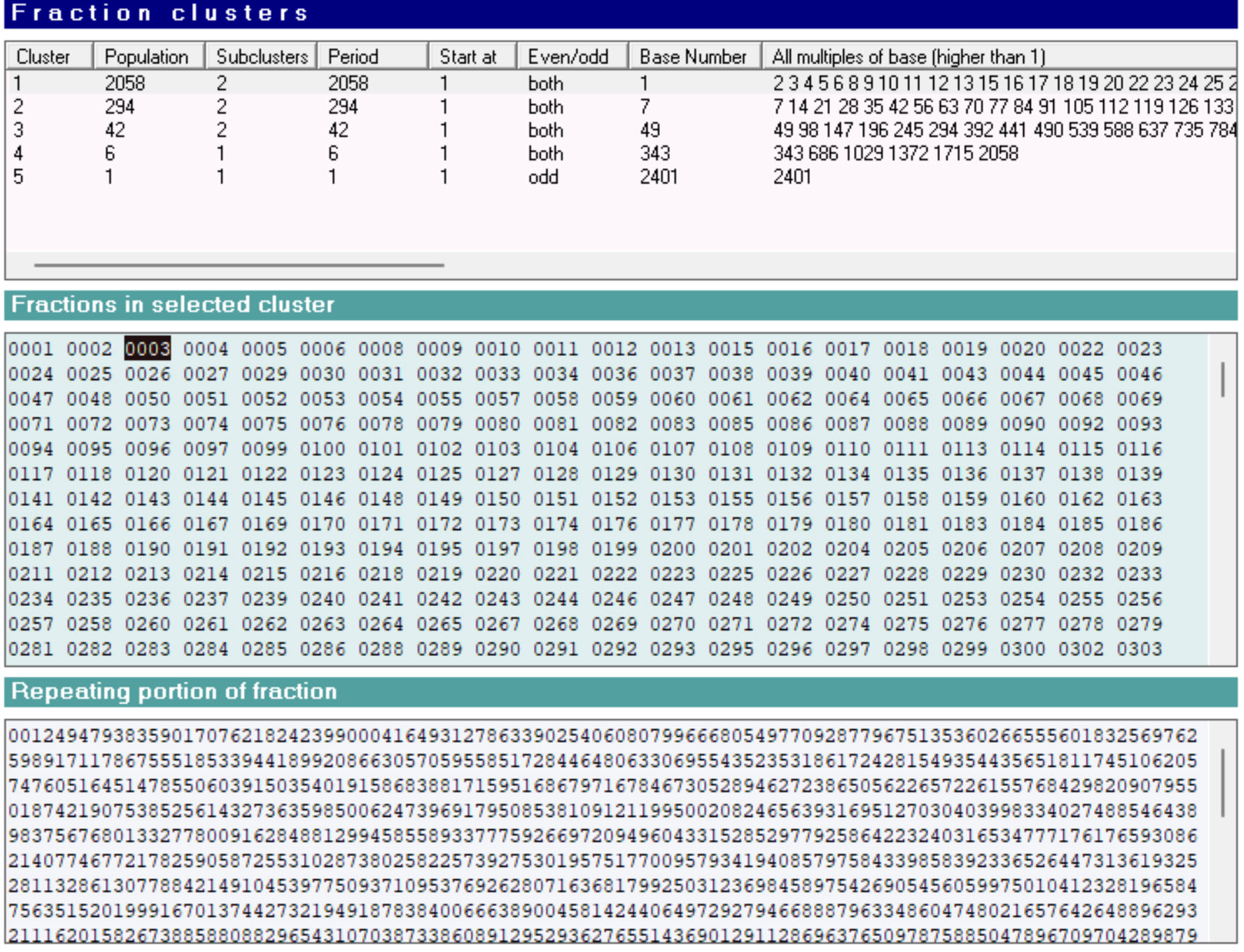
Within a given series of fractions that have a common divisor, fractions will tend to cluster in accordance with the periods of the reptends. This is one of the first things I observed when using Ardee, so it seemed sensible to to display all the clusters in a series along with the fraction list. Thus the cluster list.
A cluster is a collection of fractions that have the same reptend which starts at the same location the quotient. The list is sorted in descending order of the length of the period.
The list displays the following attributes of a cluster:
- Population How many fractions are on the cluster
- Subclusters The number of subclusters (see below) in the cluster
- Period The period of the reptends in the cluster
- start point the point in the quotient where each reptend starts
- Even/Odd Whether all the dividends in the cluster are even or odd numbers, or both
- Base The lowest dividend in the cluster, which is often the root of all the other dividends in the cluster
- a field containing a list of all the dividends in the cluster Clicking on any number in this list will display the reptend in a seperate field, and link to the appropriate fraction in the fraction list
|
| |
| Subclusters |
|
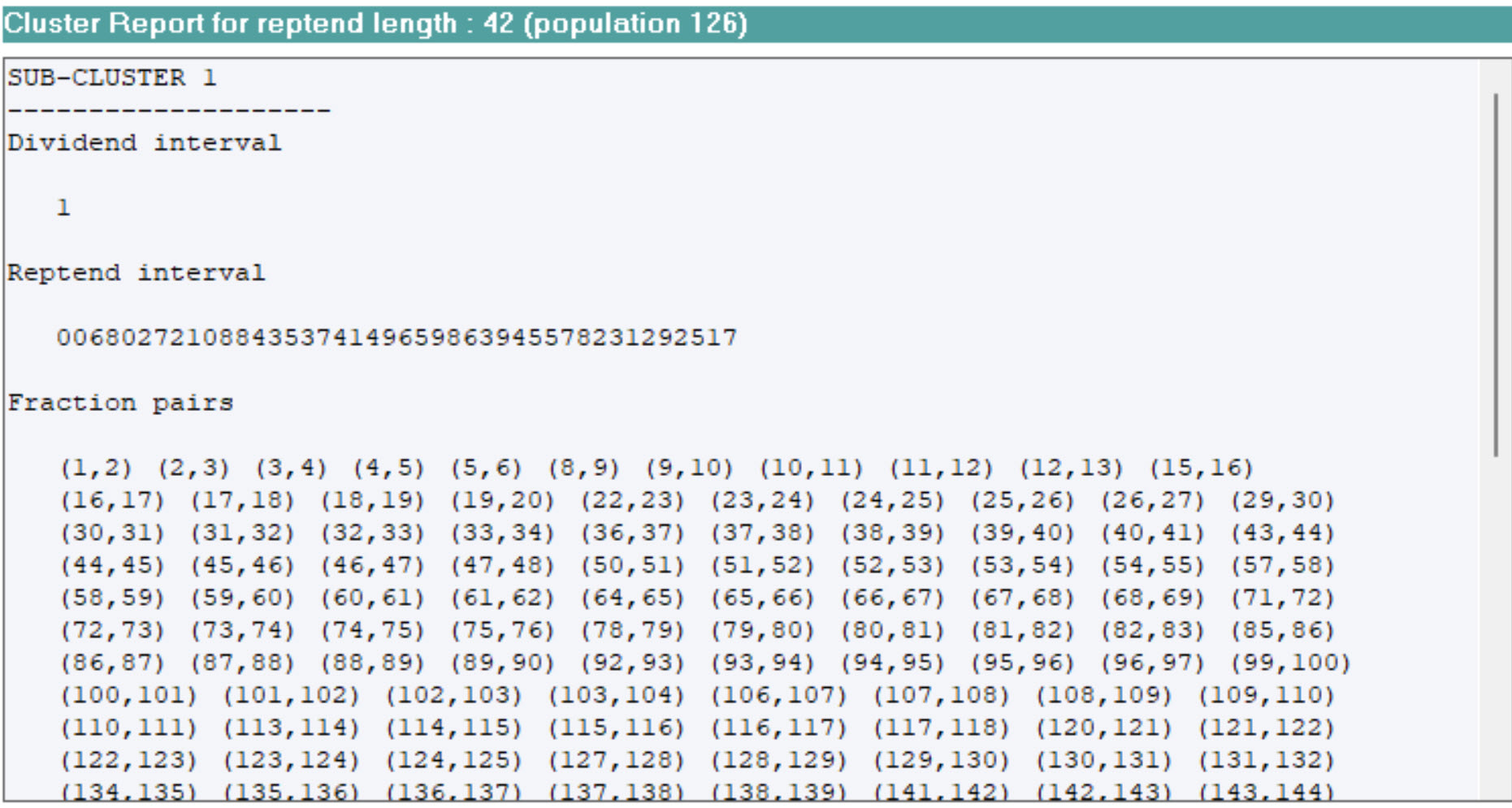
Ardee looks at the repend of each successive fraction in a cluster and substracts the reptend of the previous fraction; this gives the interval between the reptends. Then it clusters all the fraction pairs with identical reptend intervals; these are "subclusters." Usually identical reptend intervals accompany identical dividend intervals but sometimes they do not.
For each subcluster, the subcluster report pane displays the reptend interval that defines the subcluster. the dividend interval, and a list of all the matching fraction pairs.
|
| |
|
|